Last updated: 10 July 2026.
AI answering service for restaurants: what it really does, what it costs and when it isn't enough
Wednesday afternoon, empty dining room, half an hour for the paperwork. You call the bank about a card that isn't working. "Press 1 for accounts. Press 2 for cards. For everything else, stay on the line." Three minutes later you hang up, with the card still blocked. And yet now you're thinking of putting that same voice to answer your customers.
But the reason you're considering it is serious. The phone rings while you're in service or when the venue is closed, and missed calls are lost tables: open your phone's call log and count how many of last Saturday's went unanswered. The industry figure confirms it: more than four in ten calls to restaurants go unanswered, 43% (source: Forbes / Nextiva, 2024). Automating the answers makes sense. The question is with which tool, and this guide lines up the options, with what they cost and where they stop.
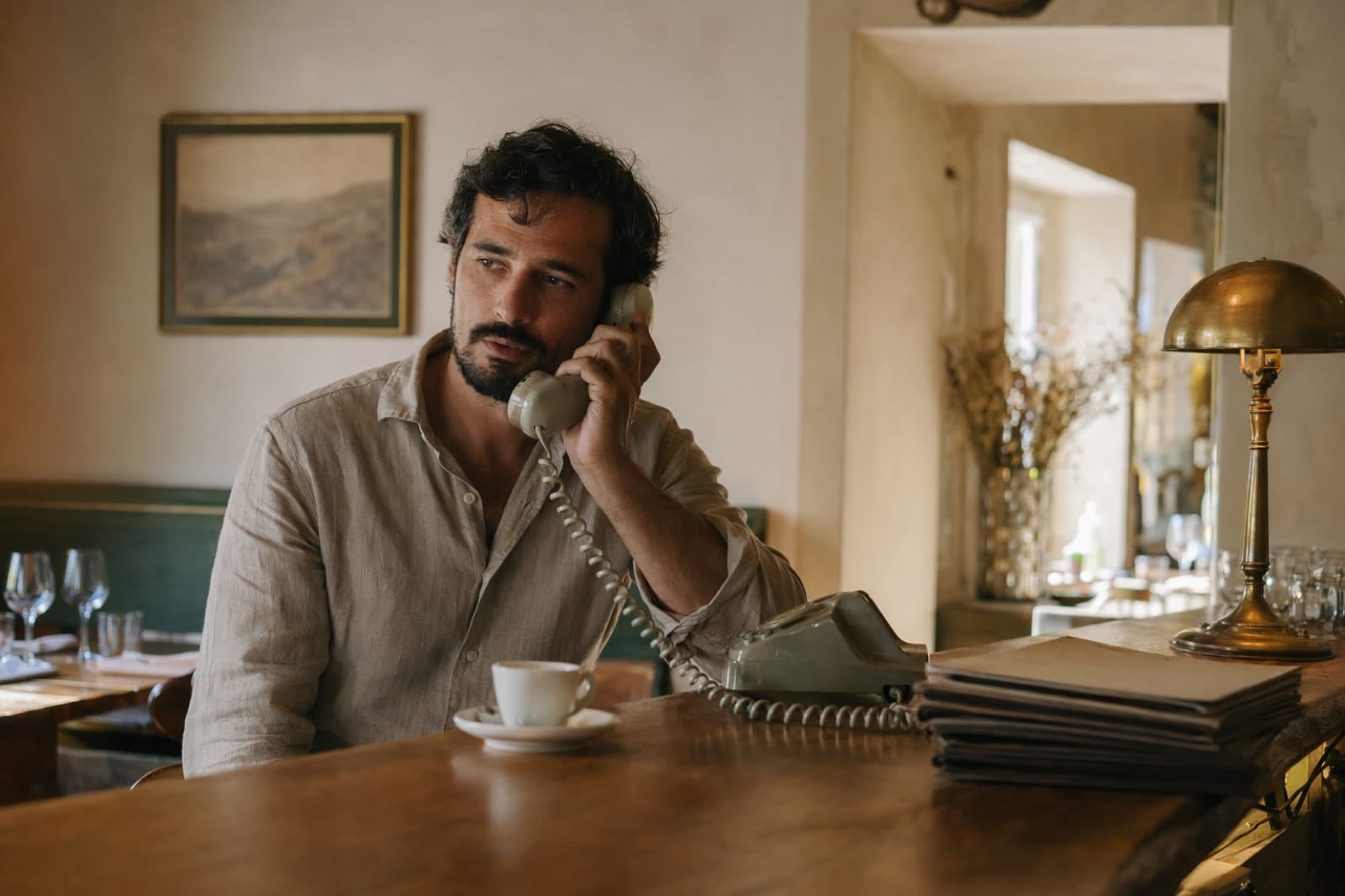
What is an automated answering service? The three different things we call by that name
An automated answering service is a system that answers calls for you with a recorded or synthetic voice. Under the same name, though, the market sells three tools that have in common only the act of picking up the receiver.
The automated message, or voicemail with a greeting. The recorded voice that plays when you don't answer: opening hours, address, "call back tomorrow". The customer listens, at most leaves a message after the beep, and the conversation ends there.
The menu answering service, the touch-tone one. The same as the bank's: "press 1, press 2". It repeats pre-recorded information and routes the call to several extensions. It was born for offices with different departments, where choosing who to speak to makes sense.
Conversational AI, the receptionist. The recent evolution: it understands the question spoken aloud, answers and completes the booking on its own. It does a different job, but those who search for it on Google still type "automated answering service".
For twenty years the term has meant the second one, so let's start there.
What a touch-tone answering service really does in a restaurant
Its real job is to give pre-recorded answers without tying you up. Opening hours, closing day, address: what you repeat ten times a week today, it repeats for you, at any hour. It also filters out some of the pointless calls, because whoever calls to sell you something, faced with a recorded menu, usually hangs up.
And it routes. If you have several sites, or a groups-and-events office, it can direct the call to the right person without anyone acting as a switchboard operator.
In an office with ten departments all this is valuable. In a restaurant the picture changes.
The limits, before you buy it
A touch-tone answering service doesn't take bookings. This limit weighs more than all the others put together: a booking is a conversation, how many people, at what time, indoors or out, a high chair for the child. A recorded menu can't lead it; it can only tell the customer to call back later, write on WhatsApp or go through the website. The work goes back to whoever called.
And whoever called often doesn't. 69% of customers give up if they don't get an answer on the phone (source: Harris Poll survey, n=2,065 US adults, 2025), and for someone who wanted a table a recorded voice that doesn't book is exactly that, a non-answer with a jingle.
Then there's the point you know from direct experience: the touch-tone menu is made for routing, and in a restaurant there's almost never a department to route to. There's you. The customer presses 1, presses 2, and in the end either hangs up or reaches your phone anyway, at the worst moment of service.
For its three jobs (information, routing, filtering) it remains a decent tool that costs little. The tool that recovers tables is another thing.
Voicemail, touch-tone menu or conversational AI: the comparison with the costs
Here are the three routes compared, with what they cost and what they leave behind: read them thinking about your typical evening, because the right choice depends almost entirely on how many calls you lose today and how much a table is worth in your venue.
Voicemail. Cost: normally zero, because it's already included with the line or the phone. What it gives: a courtesy message when the venue is closed and a recording of whoever speaks after the beep. What it leaves behind: the booking. The customer has to call back, and many, faced with a recorded voice, don't. It holds up as long as calls are few and the customers are patient regulars.
The menu answering service. Cost: roughly from €10 to €50 a month with a virtual switchboard, depending on the operator and the number of extensions; price lists vary, check yours. What it gives: pre-recorded information 24/7, routing to several phones, a partial filter on cold-sales calls. What it leaves behind: still the booking, plus the patience of whoever calls. And every change (the Christmas menu, the holidays, an extraordinary closure) means re-recording the messages.
Conversational AI. Cost: it depends on the provider; ours is public, €149/month + VAT with annual billing or €199/month + VAT monthly, all inclusive. What it gives: a real conversation that understands the request as it's phrased and carries the booking all the way, allergens and menu included. The downside: you pay the subscription even in the months when the phone rings little. Of the three it's the only one that has to pay for itself, and it pays for itself with the tables you lose today.
How Darly answers, in practice
Darly is an AI receptionist (voice + WhatsApp) for restaurants that answers the phone, manages bookings and orders, and answers guests' questions 24/7.
The difference from a touch-tone answering service is that it doesn't pass you the call: it handles it on its own, booking included. The customer speaks as they would to you. Darly checks real availability in the booking system before confirming, and doesn't say "booked" unless the table is actually recorded: the confirmation only goes out once the booking is saved.
After the voice comes the message: every booking, change or cancellation is confirmed in writing to the customer, with a reminder 24 hours before and another 2 hours before. If the venue is full, Darly offers the waiting list. And the line never gives a busy tone: if ten calls come in at once, it takes them all, and it holds more than a hundred at the same time. If the customer starts in French, the conversation carries on in French: five voice languages live (Italian, English, French, Spanish, German), with a language switch even midway through the call.
We do the setup in 24 hours: we import the menu, opening hours and rules, then we test. Customers keep calling the usual number: the plan includes a dedicated number with the AI, and we configure the call forwarding.
Where the numbers below come from: from the calls Darly handles and the results the client restaurants report back, updated to July 2026. Over 100,000 calls handled; none goes unanswered, because Darly answers even when the venue is closed or the line is busy and holds several calls at once; 98% are resolved without passing the call to a person; more than 35% of Darly clients' bookings come in after hours; and no-shows drop by 30%, measured on the client restaurants.
"With Darly, bookings come in that I used to lose: the after-hours calls, WhatsApp, the reminders that cut no-shows. In the first three months I made 25% more revenue."
That 25% is the result the owner reports for their own venue, with their own call volume: not a commitment we make for yours.
There's a single plan, all inclusive: €149/month + VAT if billed annually, €199/month + VAT if you prefer monthly. The plan is per site: one number, one venue. Do you have several sites or a group? There's the Enterprise plan on request. The trial lasts 14 days, with no credit card, and at the end of the trial no automatic charge starts.
When you're better off sticking with voicemail
If your venue's phone rings a few times a day, and almost never while you're in service, stick with voicemail: usually free, you record it in ten minutes and for that volume it does its job. The same if you work only on passing trade, with no bookings: a subscription would answer calls that don't come in.
The maths changes when missed calls are lost tables: the peak hours with the line busy, the closing day, the evening after ten. In those moments, a touch-tone answering service only leaves you with a caller who hangs up better informed.
The questions before you choose
What's the difference between voicemail and an automated answering service?
What changes is when they come into play. Voicemail is a fallback: it only kicks in after the phone has rung unanswered, records whatever the customer says after the beep, and it's up to you to call back. An automated answering service, on the other hand, answers itself, from the first ring, with its pre-recorded messages and touch-tone menu. Neither one completes a booking; the AI receptionist is the third category, the one that leads the conversation and closes it on its own.
Can an automated answering service take bookings?
A touch-tone one can't: at best it points the customer to another channel, a website or a number to call back. An AI receptionist can, all the way: it asks for the number of people, the time and the preferences, checks real availability and, if the venue has several areas (indoors, garden, veranda), asks the customer where they'd rather sit and assigns the table in the right area.
Do I have to change my booking system or give up my diary?
No. If you don't have a booking system, Darly includes DarlyBook, its own booking system: you start from there without installing anything else. If you already have a system, Darly integrates with it, for example TheFork or Google Calendar, and the bookings arrive where you already work. In both cases the place where you read your bookings stays a single one, kept up to date by Darly on every call.
How do the trial, price and cancellation work?
The trial lasts 14 days, with no credit card: it ends on its own, with no automatic charge. Then you choose: the monthly plan at €199 + VAT can be cancelled whenever you like; the annual one at €149 + VAT costs less and is a 12-month commitment. The plan is per site; for several sites or a group there's the Enterprise plan on request.
Do I have to change my restaurant's phone number?
No. During setup you get a dedicated number for the AI and we sort out the call forwarding: your customers keep calling the number they've always called. Transfer to a person is always possible and you configure it the way you prefer: for severe allergies, for example, Darly passes the call straight to you or your staff.
And cold sales calls? Do I keep getting them?
The anti-spam filter blocks them: recognised cold-sales calls no longer reach the floor. Smokehouse in Bassano del Grappa, before switching Darly on, used to say it wasted a lot of time answering spam numbers; today it has taken that time back.
Can it also handle takeaway orders?
On request, yes: if you switch the feature on, Darly takes takeaway and delivery orders on the phone and sends them straight to the till. It also suggests the right add-on at the right moment, a drink or a dessert, without pushing the sale.
What happens if a tourist calls in another language?
Darly answers in their language, if it's one of the five live ones: Italian, English, French, Spanish and German. Language recognition is automatic and can switch even during the same call. On WhatsApp the languages covered are 20.
Hear it, then decide
To judge an answering service there's only one test that counts: calling it.
Darly's demo line is +39 379 3697960: ask it the questions your customers ask, in the messy way they ask them. No button to press: you just talk. Then, if you like, you try it on your own number for 14 days, no card.
To understand in detail how an AI phone system for restaurants works, read our full guide on AI phone systems for restaurants. If instead your specific problem is missed calls at peak times, we've written about it here.
Last updated: 10 July 2026.